
Recently I purchased a new lens to replace my original Sony 55-210mm kit lenses. When I started researching a new telephoto lens, I quickly bypassed the usual social media and gear forums. The trend lately seems to be an obsession with having the sharpest lens possible, and many people are buying purely on sharpness alone. Sharpness matters of course, but it’s far from the only characteristic that defines a great lens.
When I evaluate a lens, I look at the whole picture. I want to know whether it delivers optical sharpness across the frame, and is the lens compact, lightweight. I also check how fast and reliable the autofocus feels, whether the lens includes effective image stabilisation, and how well it handles focus breathing, something that matters more than people realise. I also look for minimal barrel distortion and strong control over chromatic aberration. A lens is more than a sharpness chart, it’s a balance of features, handling, and performance, and that’s what I look for in a lens.
After doing my research I narrowed it down to the following three lenses: the Sony 70–350mm G OSS for longer reach and sharp telephoto work, the Tamron 18–300mm F3.5–6.3 DI III‑A VC VXD for a highly versatile all round zoom, and the Sigma 16–300mm f/3.5–6.7 DC OS Contemporary lens as a compact, wide to tele option. After considering my needs and shooting preferences, I chose the Sony 70–350mm G OSS Lens because I felt its range and characteristics suited my style of photography.

Boat Sheds at the Grove Arm, in the Marlborough Sounds, New Zealand
I’ve always been drawn to the freedom of handheld shooting, the kind where the camera becomes an extension of your hand, not something hanging from your neck. With a wrist strap and a lens that weighs in at 625 grams, the setup feels balanced, almost effortless, as if it was built for wandering. Out in the field, image stabilisation becomes the quiet hero of the story. The switch on the lens doesn’t just control its own stabilisation, it also takes command of the Sony A6700’s IBIS, giving me full control with a single click. When the camera goes onto a tripod, I just flick the switch to off, so to avoid any stabilisation related wobble. The photo above was taken handheld at 350mm, early afternoon, on a windy Marlborough day, not exactly calm conditions. I was also running a PolarPro VND + CPL to keep the light under control.
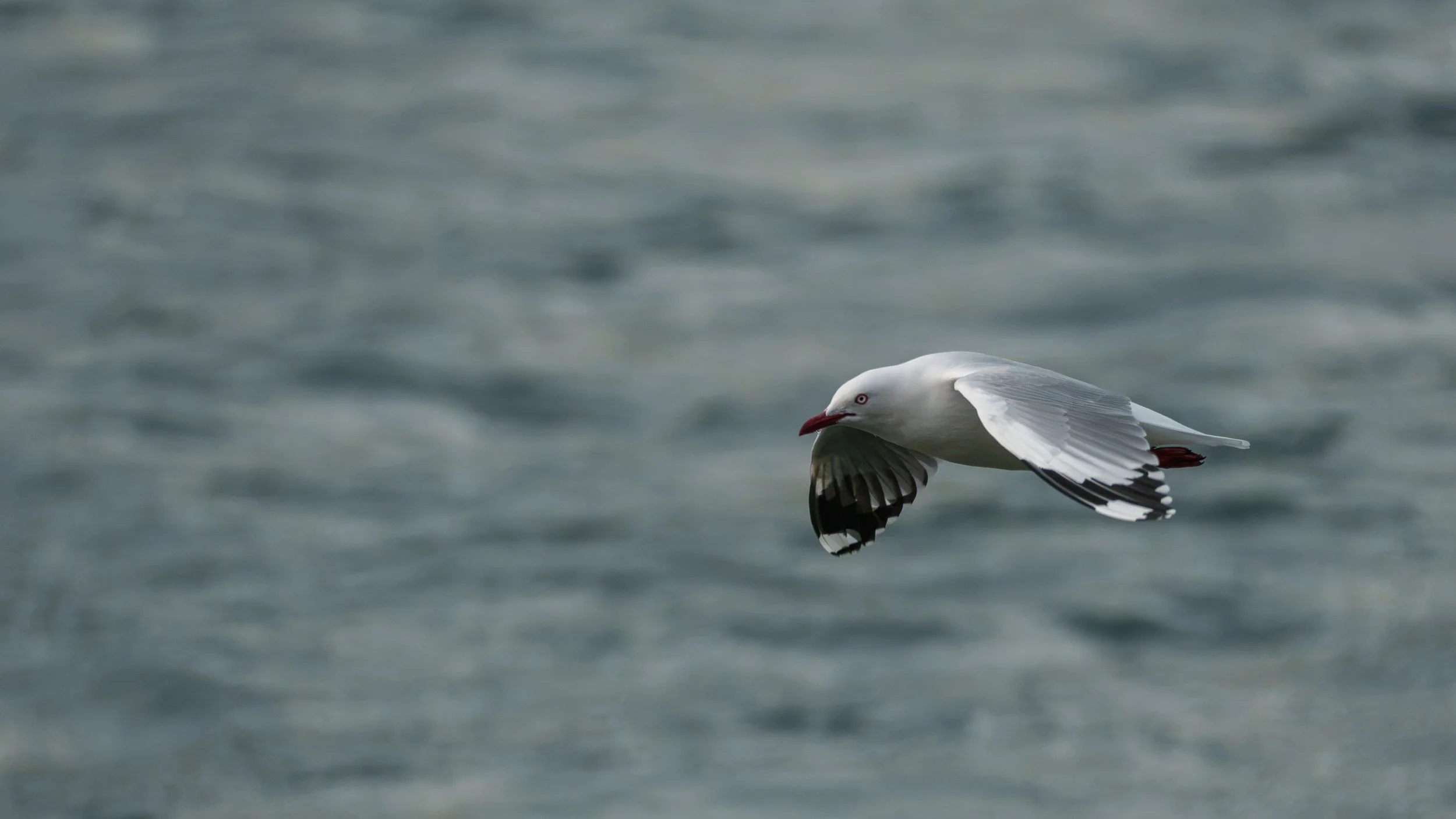
Red Billed Gull
Sony 70-350mm G OSS for Bird and Wildlife Photography
With purchasing the lens I also wanted to start capturing birds in flight and wildlife in general, so speed and responsiveness were important to me. Having super fast autofocus is a must for those situations, and with subject recognition and subject tracking enabled the autofocus consistently locks on and follows moving birds or other wildlife with high precision. While using the lens I have not noticed any significant barrel distortion across its entire focal length. Chromatic aberration is very well controlled for the most part, on a few occasions I have seen mild bokeh fringing with a green or purple tint in heavily blurred backgrounds when shooting wide open, but that is easily corrected in post production.
As the Sony A6700 is a hybrid camera, having lenses that perform well with video is very important to me. This lens exhibits very minimal focus breathing across its entire zoom range, which is a real benefit for moving shots and focus pulls. When you pull focus from near to far, objects in the frame barely shift in size, maintaining a natural, professional look. Overall I find the lens delivers excellent video footage. I’ve already shot some video of birds at the Taylor Dam and will continue to capture birds and wildlife video with it.
When researching the lens, one of the limitations I noted was its slow, variable aperture. With an aperture range of f/4.5–6.3, it admits less light than faster lenses, which makes shooting in low light situations more challenging without pushing the ISO and risking increased noise. I suppose this is the kind of compromise you accept instead of purchasing a much more expensive constant f/2.8 lens.
Another issue I encountered was a tripod problem. The ball head on my Ulanzi 3029 Ombra YING Travel Tripod isn’t robust enough to support the weight of my lens when it’s fully zoomed out to 350mm. To keep the lens steady I had to over tighten the locking nuts on the ball head, and over time the lens would slowly droop downward. I also worried that repeatedly over tightening might damage the ball head, so I switched to using one of my older, more heavy duty tripods whenever I mount that lens.
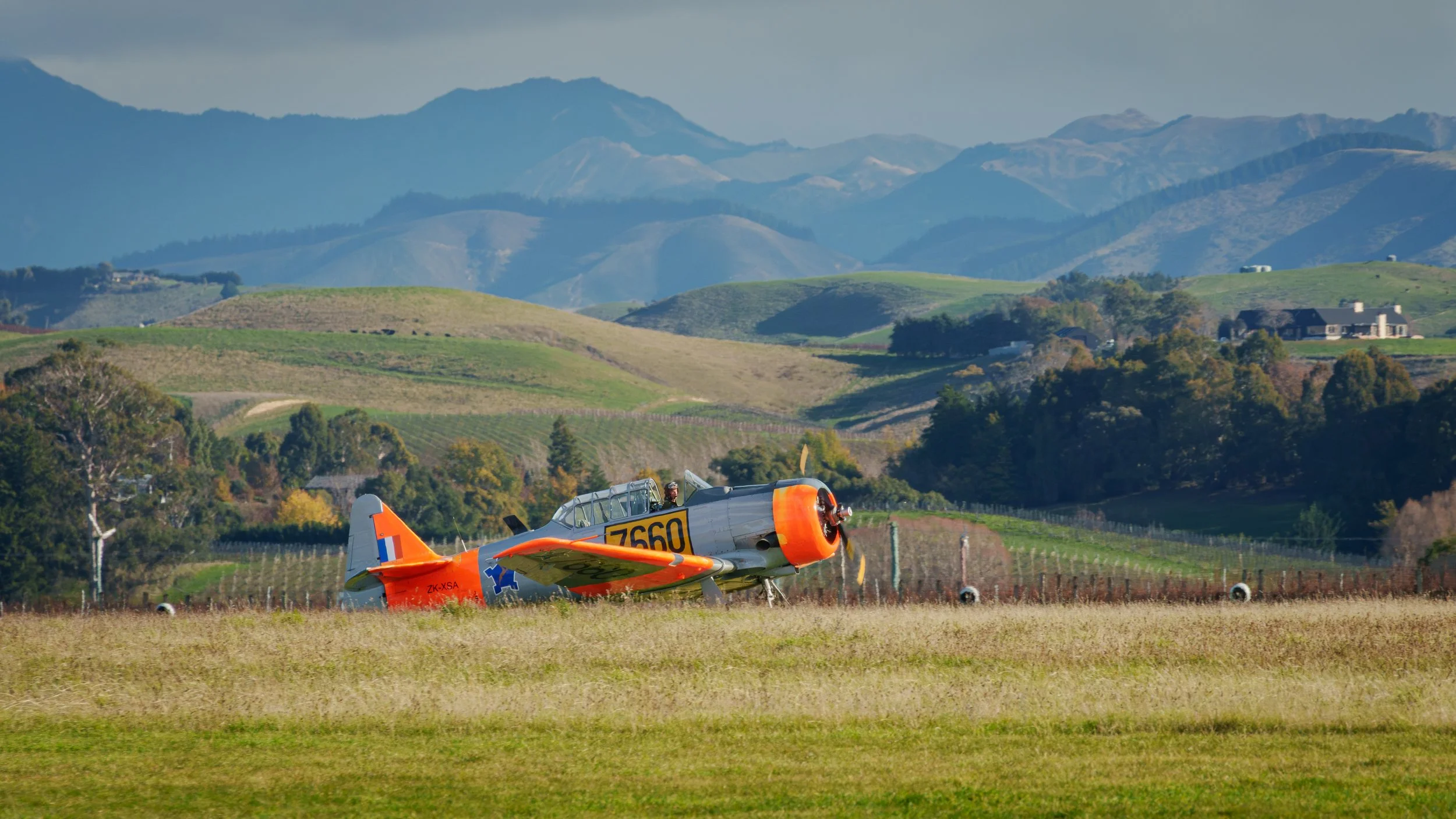
A Harvard that had just landed at Omaka Airfield
As I photograph New Zealand landscapes and have increasingly taken up bird and wildlife photography, this lens is arguably the best purchase I have made for my Sony A6700 APS-C camera. The Sony 70-350mm f/4.5-6.3 G OSS lens has been an excellent addition to my camera bag for both stills and video, offering a versatile 105–525mm 35mm full-frame equivalent focal length range that covers everything from distant wildlife to compressed landscape details.