
What’s in My Camera Bag 2026. The Ultimate Hybrid Kit
What’s in my camera going into 2026 is quite different from what I had back in November 2019 when I purchased the Sony A6100 — my very first interchangeable-lens camera.

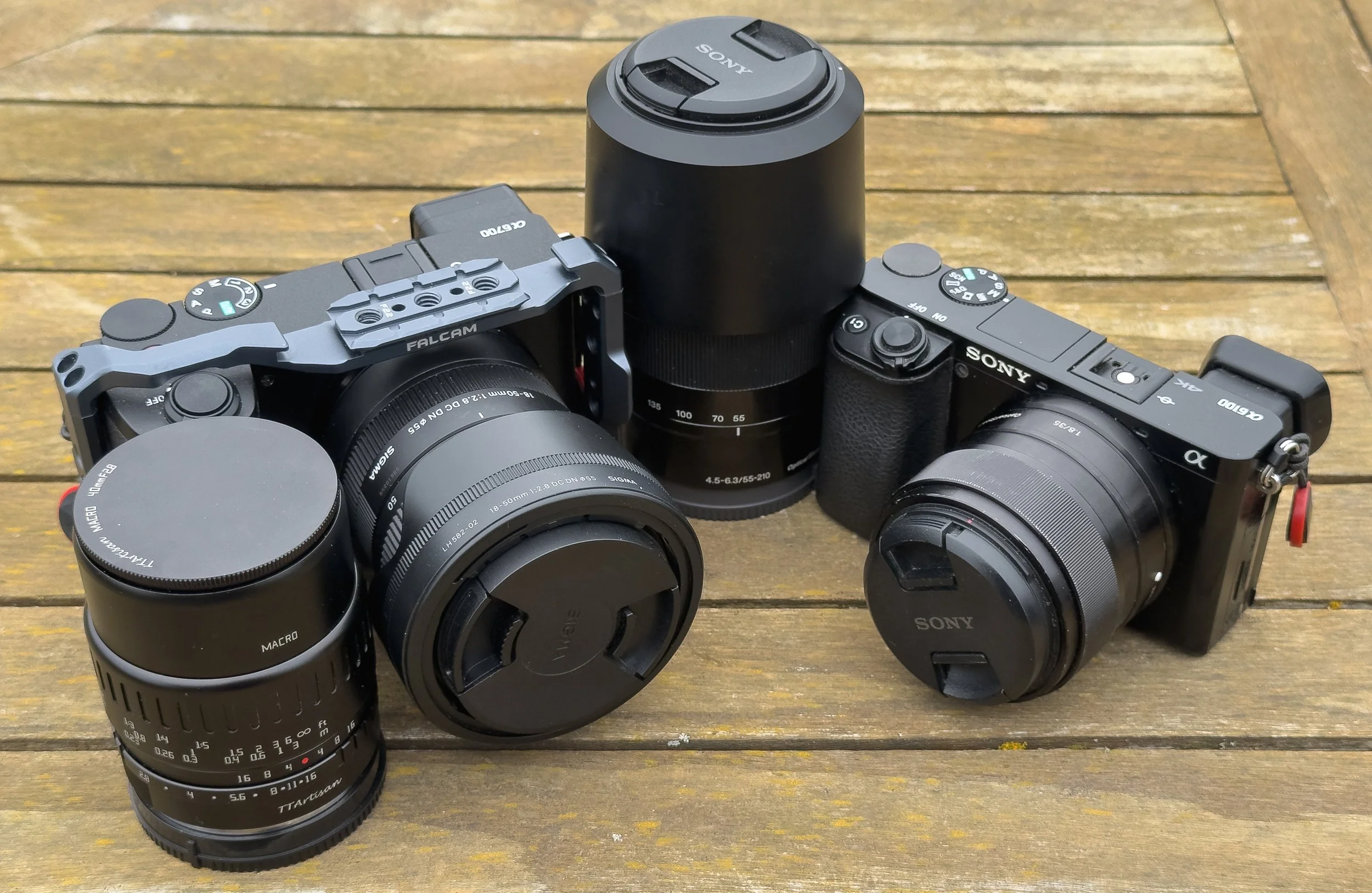
Looking back, would I have done anything differently? Yes — and the one thing I would have changed was that, instead of purchasing from a big-box appliance store that, incidentally, sold me not one but two kit lenses, which are the Sony 16-50mm and the Sony 55-210mm lenses, I would have gone through a dedicated camera shop and bought only the camera body first, then carefully selected lenses best suited to the style of photography I wanted to pursue. Kit lenses can at times be a little limiting, yet I learned how to get the most out of them and still managed to produce some really amazing photographs.
As a photographer we sometimes feel like we don’t have enough lenses or photography equipment, and that can lead to what many call GAS — Gear Acquisition Syndrome. After doing some research at the time, I bought two prime lenses: the Sony 35mm f/1.8 and the Samyang 12mm f/2. The 35mm quickly became my go‑to for everyday shooting, alongside the Sony 55–210mm zoom for longer reach. The Samyang is an ultra‑wide lens, and what I didn’t fully appreciate at first was just how wide it was: there’s quite a lot of distortion, especially around buildings, which demands considerably more work in post‑processing to straighten lines. The Samyang is also optimised for astrophotography, making it excellent for night skies but less forgiving for architectural work.
In 2024 I purchased the TTArtisan 40mm f/2.8 1:1 macro lens. This lens is manual-focus, and although it took a little time to get used to the focusing method, the macro photos I’ve produced with it are truly impressive. A few months after that purchase I felt it was the right moment to upgrade my camera body. I had previously dabbled in video and wanted a camera that would serve both stills and video work well. In my research I considered switching to a full-frame system, but because I already owned several APS-C lenses the cost of moving to full frame would have been prohibitively high. Ultimately I chose the Sony A6700, which fit my needs perfectly — a 26MP APS-C camera with excellent video capabilities. I also decided not to sell my Sony A6100, since it was my first interchangeable-lens camera, and because it remains a very capable body it will serve well as a reliable backup camera.
Changing to the Sony A6700, my plan was to replace my kit lenses. The first kit lens I chose to replace was the Sony 16–50mm. My research narrowed the options to two contenders: the Sigma 18–50mm f/2.8 and the Tamron 17–70mm f/2.8. Both lenses had their pros and cons, but in the end I selected the Sigma 18–50mm f/2.8 — it also offers a close 1:2.8 macro capability and performs very well for video work. The Sony 16–50mm kit lens was then advertised for sale and was sold within a couple of weeks. As I was no longer using the Samyang 12mm f/2 lens as much as I had hoped I would, and having only taken it out a couple of times this year, In December I felt it was the right moment to sell it. I also purchased the Falcam camera cage; it has three cold shoe attachments on the cage, which gives me the flexibility to add cold-shoe accessories such as lights, a microphone, an external monitor, or a mobile phone. That way I won’t risk damaging the camera’s hot shoe. What I particularly like about this Falcam cage is that you can still access the battery compartment and SD card slot without removing any part of the cage, and you can mount remotes for microphones and flash triggers in the hot shoe without needing hot-shoe extensions.
The plan in 2026 is to replace the Sony 55–210mm kit lens; I had contemplated selling the Sony 35mm lens, but it pairs very well with my Sony A6100 camera body so I’ve kept it. A couple of the main advantages the Sony A6700 offers are the touchscreen and many more customisable buttons that can have different settings programmed for each one. This is a particularly useful feature because you can assign different configurations to buttons depending on whether you are in photo, video, or S&Q mode. It also includes programmable menus on the mode dial. A good example: in photo mode I have Menu 1 set to Action Photos, Menu 2 set to Handheld Photos, and Menu 3 set to Tripod Photos. In my camera bag I always leave it set to Menu 2, Handheld Photos, so I can grab the camera and it’s ready to go; with the customisable buttons I can tweak settings on the fly and avoid missing a shot. That also means I rarely need to fumble through the main settings menu, which reduces the chance of losing a photo opportunity.
Going into 2026, I’m very happy with the camera setup I now have, and I’m looking forward to getting out into the field to capture some great photos and video.